Fire collars and wraps
Plastic pipes burn through. A collar or a wrap closes the hole when they do.
Get a priceA plastic pipe does not last long in a fire.
Once it melts, it leaves an open hole through the wall or floor. A collar or a wrap is there to close that hole.
How they work
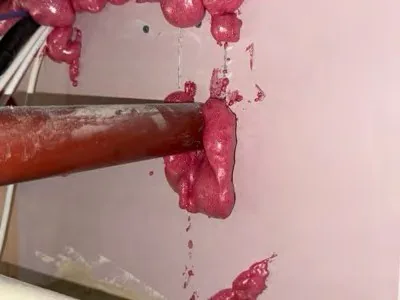
Both contain intumescent material. It stays thin and quiet until it gets hot, then it swells and squeezes the softening pipe flat.
A collar is a metal ring with the material inside. It goes round the pipe and is screwed to the wall or the underside of the floor.
A wrap is a strip of the material, wound round the pipe a set number of times and held with a band, then pushed into the opening.
When each is used
Collars suit pipes that come through a floor slab, like waste pipes and soil stacks, where there is a flat underside to fix to. They are common in blocks of flats, where every bathroom has a pipe passing through the floor.
Wraps suit pipes through walls, tight spaces and runs where there is no room for a collar.
Either way, the details come from the manufacturer's tested instructions. They say how many wraps for which pipe diameter and what to do with the gap round the pipe.
What goes wrong
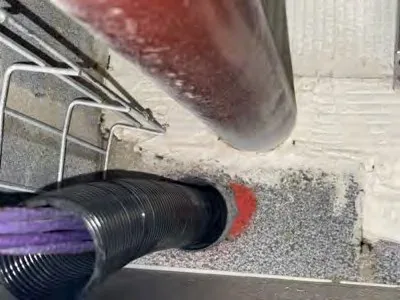
Wrong size. A collar for a 50mm pipe does nothing useful on a 110mm one.
A collar that is fitted but not fixed, or held on by a single screw.
A pipe sleeved in something that stops the collar working.
A collar fitted in a wall made of a different material from the one it was tested in.
A boxed-in pipe where the boxing has been cut and the collar is out of reach.
What we do
We check each pipe against the wall or floor it passes through, then fit the right unit. Gaps round the pipe are filled with mastic or mortar as the product detail says.
The work is carried out by our BM TRADA / FIRAS-certificated contractors. Each one gets a photo and a number.
Questions we get asked
Do I need collars on metal pipes?
Normally not. Metal pipes need other precautions, such as sealing the gap and keeping the insulation intact.
Can I fit them myself?
You can buy collars. Getting the size, the fixings and the gap right is the part that matters, and a good seal looks much the same as a bad one at a glance.
Send it over with the postcode. We will tell you what the work involves and roughly what it costs.
Get a price