Every pipe through a fire wall is a hole in it.
The hole needs filling with something that will hold for as long as the wall is rated. Not whatever was in the van.
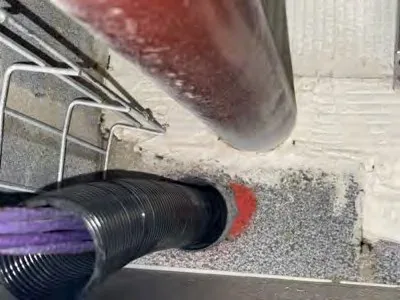
Why the product matters
A fire seal is tested as a whole. The test covers the wall or floor, the pipe or cable, the gap around it and the product. Change one of those and you are outside the test.
So a seal that works in a block wall may not be right for plasterboard. A seal for a 32mm plastic pipe is not the answer for a 110mm one.
That is why we want to know what the wall is made of, what is going through it and how big the gap is.
What goes where
Cables and small gaps. Intumescent mastic, which swells when it gets hot and closes the gap.
Bundles and trays. Batts or pillows packed in, and the face sealed. In the photo further down, two trays pass through a wall with batt packed round them.
Plastic pipes. A collar or a wrap, which squeezes the pipe shut as it melts.
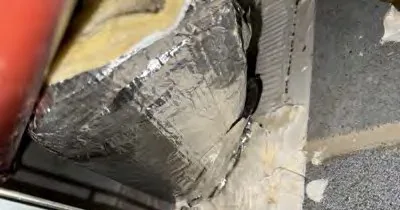
Metal pipes. It depends on the lagging. A metal pipe carries heat across to the other side, so the insulation and the seal both matter. Torn foil lagging at a seal is something we look for.
Large openings. Coated board, mortar or a pre-formed unit. A tray was taken out, say, and left a hole the size of a door.
Problems we find
Foam from a can. Ordinary expanding foam burns. Fire foam is a different product, often red or pink. We answer that here.
Gaps round a pipe that are bigger than the seal was tested for.
Seals broken by the next trade, who ran a new cable straight through them.
A seal on one side of a wall only, where the product needs fitting on both.
What you get back
Each seal has a number, a position, a note of the product and a photo. It goes in a record you can hand to the assessor, the building owner or the insurer.
Our BM TRADA / FIRAS-certificated contractors do the sealing.
Questions we get asked
Can I reuse an old seal?
If it is intact and the right product, yes. If a cable has been added, it is a new gap and gets treated as one.
Do I need to seal on both sides of a wall?
Often, yes. The manufacturer's detail says. We follow it.
Send it over with the postcode. We will tell you what the work involves and roughly what it costs.
Get a price